Type 1, on a five-minute loop
Type 1 diabetes
I was diagnosed in November 2023, in an ICU. My insulin is now dosed by my own fork of Loop, an open-source closed loop that I run and maintain myself.
- Diagnosed
- Nov 2023
- Age at diagnosis
- 26
- Sample interval
- 5 min
- HbA1c
- 4.9%
Reported values from my own records, not a live feed. The live glucose trace is on the home page. Insulin and carbs still on board sit with the loop below.
November 2023
Diagnosis
It started as what felt like a cold, then a bad flu. I was admitted to intensive care at 108 pounds and six feet tall, in severe diabetic ketoacidosis, with an HbA1c over 15% and positive GAD65 antibodies. The DKA tore muscle and left a hematoma. I went home on a walker, moved to a cane, and walk normally now.
For two or three years before that there were small symptoms, and they were dismissed. Adult-onset Type 1 gets missed regularly, because the working assumption is that Type 1 is a childhood diagnosis. It is not.
Type 1 is autoimmune. The immune system destroys the insulin-producing cells in the pancreas. Nothing I did caused it, nothing reverses it, and there is no cure yet. Insulin is not optional and it is not a lifestyle intervention. People die when they cannot afford it.
Sense, decide, deliver
The loop
Loop is open-source software written by people with diabetes. It reads a continuous glucose monitor, decides how much insulin to deliver, and drives an insulin pump. I run my own fork of it on a Dexcom G7 and an Omnipod 5. It is a feedback controller on a five-minute tick.
Read the Loop docs (opens in a new tab)My fork of Loop01 sense
A Dexcom G7 reads interstitial glucose
The sensor sits on my arm and streams to my phone. 288 readings a day, without finger sticks.
every 5 min
02 decide
Loop projects forward and picks a dose
The algorithm runs on the phone. No server in the path, so it keeps working with no signal.
30-60 min horizon
03 deliver
An Omnipod 5 pod delivers it
The pod adjusts basal rate and gives micro-doses of Lyumjev. Nothing to carry, nothing to charge.
continuous
4.18U
insulin
3.9g
carbs
Loop on-board: 4.18 units of insulin still acting, 3.9 grams of carbohydrate still absorbing, 4 min ago. The plot under the gauges is twenty-four hours of those remaining quantities. Insulin is below the midline; carbs are above it; the glucose they move is traced underneath.
That is 288 readings a day and a dosing decision on each one. The loop does the arithmetic; the rest of it is still mine. Sensors fail, pods occlude, and a low at three in the morning still needs carbohydrate and attention. My HbA1c came down from over 15% at diagnosis to 4.9% on the loop.
The DIY community built this before commercial systems got to the same place, and published it as source anyone can read, audit, and run. The tag it organized under is #WeAreNotWaiting.
Where I put time
DIY Loop community
I run my own fork of Loop and spend time with the people who write and maintain Loop.
Breakthrough T1D Walk
I walk the Westchester event every year to raise money for T1D research.
Insulin access
Insulin and pump supplies are a cost problem. Nobody with Type 1 gets to skip a month.
Breakthrough T1D, formerly JDRF, is the largest funder of Type 1 research. I walk the Westchester event each year with Team Yannelli.
Organizations
Most of these fund or build diabetes technology. NGLCC NY has nothing to do with diabetes and is here because I support it.
Breakthrough T1D
The largest funder of Type 1 research. Formerly JDRF.
Donate or join a walk ↗ (opens in a new tab)Loop
An open-source closed-loop insulin system built by the DIY diabetes community.
Read the docs ↗ (opens in a new tab)NGLCC NY
The New York affiliate of the National LGBT Chamber of Commerce, for LGBTQ+-owned businesses.
Visit ↗ (opens in a new tab)
Reading
All writingBlog · ryanyannelli.com
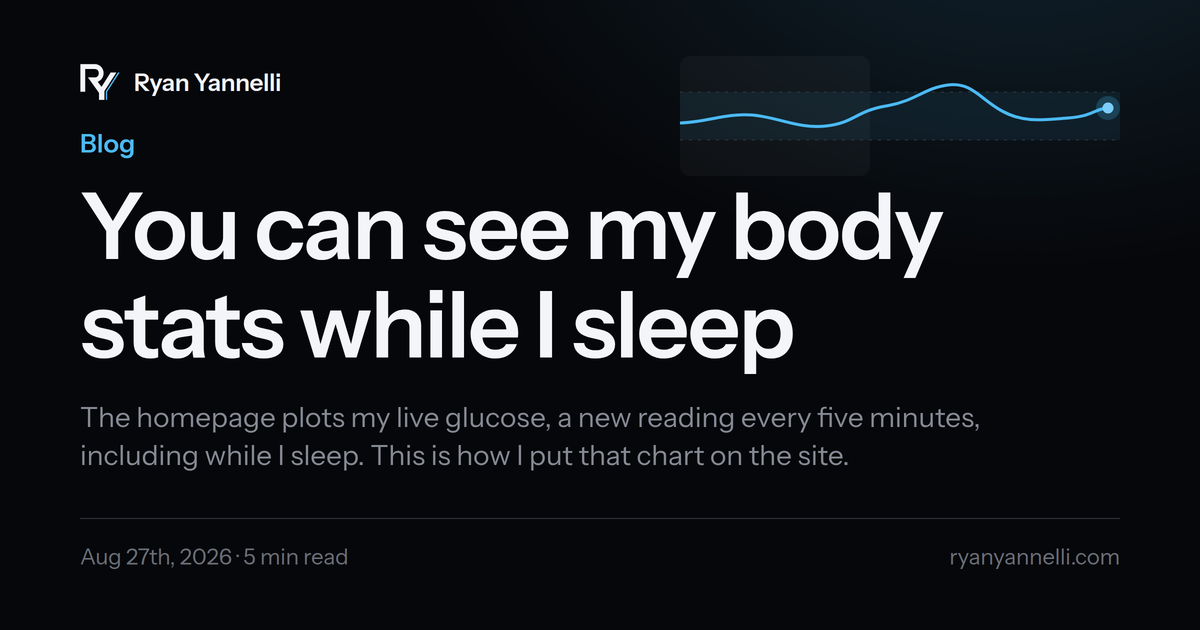
You can see my body stats while I sleep
Blog · substack.com
We Build AI for Healthcare. Why We’re Refusing to Scale Empathy.
Blog · ryanyannelli.com
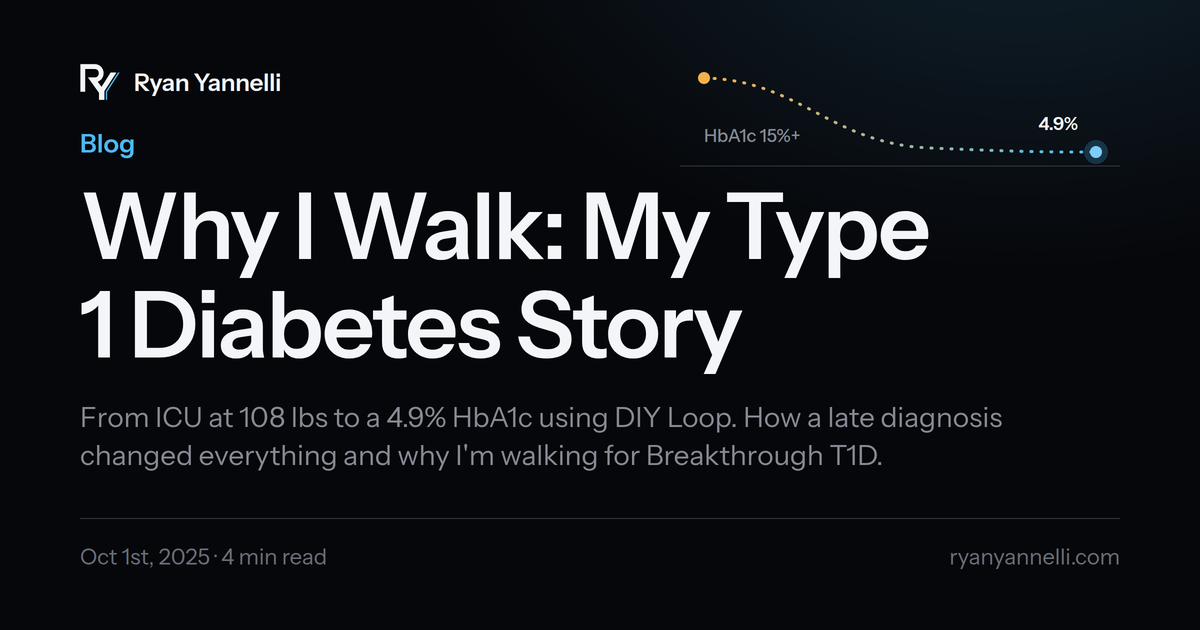
Why I Walk: My Type 1 Diabetes Story

If you were recently diagnosed, are running Loop, or are building in this space, get in touch. I answer these.