 Dolum
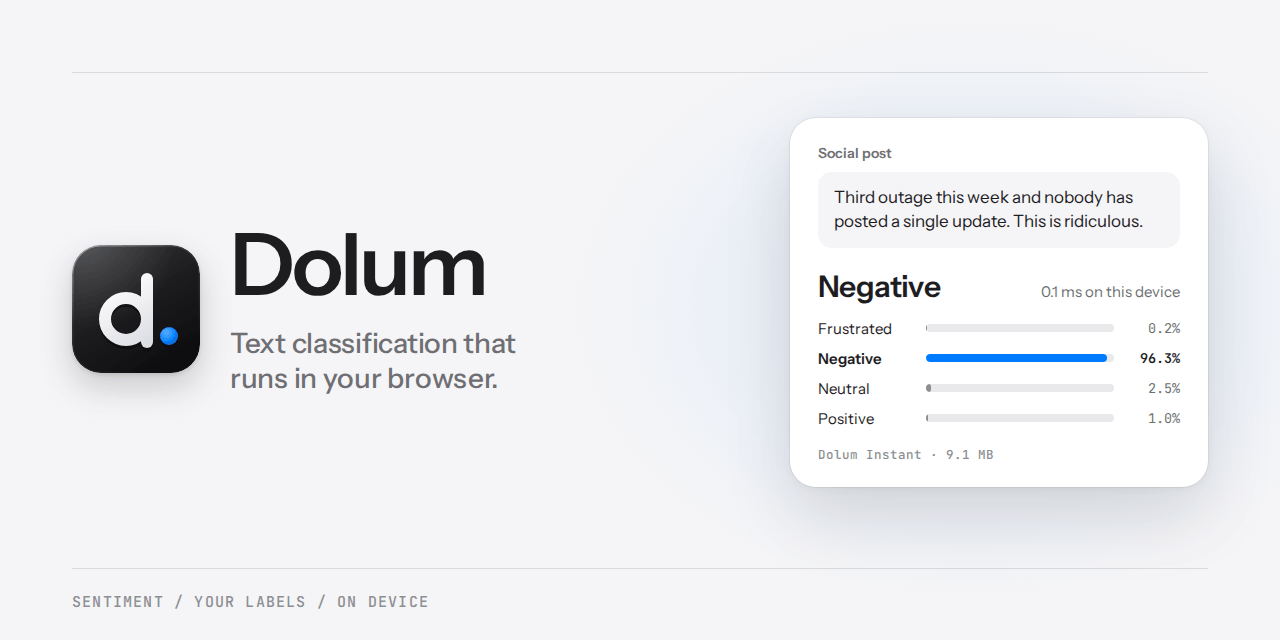
Type a support call, a review, or a post, and Dolum labels it frustrated, negative, neutral, or positive.
It started as an experiment: a local take on TypeSafe’s Jev API, with the same three kinds of answer. Pick one label from a list, rate on a scale, or answer yes or no, all without a hosted model. Sentiment is what trydolum.com runs by default.
How it works
Dolum answers in two steps. A small model answers right away, and a larger one refines the answer if you load it.
| Model | Size | What it does |
|---|---|---|
| Dolum Instant | 9.1 MB | A 6.7 MB word network and a 2.4 MB support-call specialist. Loads with the page and answers in milliseconds. |
| Dolum Large v1 | About 313 MB, once | Twitter RoBERTa large, fine-tuned and exported to ONNX with 4-bit and 8-bit weights. Reads each word in context. |
Support calls run a lot longer than reviews and posts, so anything 48 words or longer goes to the call specialist.
The large model downloads in 16 MiB chunks. Each chunk is checked by SHA-256 and kept in the browser’s cache, so it only downloads once. It runs in a Web Worker on WebAssembly, so the page stays responsive while it works.
Results
Every system was scored on the same test rows: 13,644 general rows from SST-2, SST-5, Rotten Tomatoes, TweetEval, and an emotion set, plus 120 support calls that no model trained on. The calls are the customer side of generated e-commerce support chats.
| System | General rows | Support calls | Median latency | API cost per million rows |
|---|---|---|---|---|
| Dolum Large v1 | 87.5% | 89.2% | 205 ms, in the browser | $0 |
| Jev 1.13 | 69.8% | 47.5% | 159 ms | $19.33 |
| GPT-6 Luna | 68.2% | 41.7% | 321 ms | $29.13 |
Jev and GPT-6 Luna got one row per request with the same label guide, and their latency includes the network. Dolum’s latency was measured in headless Chromium on 16 vCPUs with 4 WebAssembly threads. The instant model alone scores 78.0% on the general rows and 88.3% on the calls.
On 602 of the 13,644 general rows, all three systems agree on a label the dataset doesn’t have, and 434 of those are from TweetEval.
Your own labels
The Train page fits a model on your own labeled rows, either in the browser or on a GPU trainer you run. When you train in the browser, the rows stay on your device, and the model is saved there too.
Underneath, the decision engine answers a question you write. A Choice picks one of your labels, and a Score rates text on a scale of 2 to 10 levels. One bank holds up to 32 classifiers, each with its own question. Dolum A0 Base, at 22.9 MB, answers a question over labels you name without training first.